

Beyond Office Recycling: Unlocking True ESG Impact
When your organisation faces a relocation, refurbishment or hybrid working consolidation, the instinct is often to search for “office recycling removal” and find someone to haul away unwanted office furniture. It feels responsible, recycling sounds sustainable, and most clearance firms promise some form of material recovery.
But here’s what independent UK and EU studies consistently show: reuse typically saves six times more CO2e than material recycling for office furniture. The desk you’re about to send for shredding could instead spend another decade in a classroom in Gambia, Romania or right here in the UK. And the cost? Often comparable to traditional recycling-only clearances or skip hire, but with measurable ESG reporting and genuine social impact built in.
Waste to Wonder Worldwide is a social enterprise that offers an alternative to standard disposal. We collect surplus desks, chairs, storage units and IT equipment from offices globally and redistribute them to schools, charities and community projects worldwide, before recycling anything. This article will first explain what standard office recycling removal involves, then demonstrate how a reuse-first approach delivers better environmental, social and financial outcomes.
Three reasons to choose reuse over recycling:
-
Greater carbon savings (reuse avoids manufacturing emissions entirely)
-
Similar cost to traditional clearance service options
-
Measurable global impact, your old furniture furnishes real classrooms

What “Office Recycling Removal” Usually Means for UK Workplaces
Picture a familiar scenario: a Manchester or London office is closing a floor in 2026. The facilities team contacts a clearance firm or orders skips to “recycle” everything. The furniture disappears, paperwork is signed, and everyone assumes the job is done responsibly.
But what actually happens in conventional office furniture recycling? The process typically involves:
-
Bulk collection: Mixed loads of desks, chairs, pedestals and equipment are removed without detailed sorting
-
Material recovery facility processing: Items are separated into metals, wood, plastics and textiles
-
Limited re use rates: Furniture in good condition is often shredded alongside broken items
-
Residual waste disposal: What can’t be economically processed goes to energy-from-waste or landfill
-
Minimal reporting: Clients receive basic compliance certificates, rarely detailed impact data
Common items involved include bench desks, task chairs, pedestals, filing cabinets, meeting tables, whiteboards, lockers, reception furniture and electrical items.
The perception “we recycled everything” rarely matches the reality. Most office recycling services prioritise material recovery over keeping intact furniture in circulation. Social value from usable assets is lost. Old office furniture that could serve communities for years gets reduced to raw materials, requiring energy-intensive reprocessing before becoming anything useful again.
Why Reuse Outperforms Recycling for Office Furniture
The difference between reuse and recycling is simple but significant. Take a typical 1600mm bench desk and ergonomic chair. Recycling breaks these down into constituent materials, metal frames melted, wood chipped, plastic shredded, which then require substantial energy to reprocess into new products. Reuse keeps the entire item in circulation, avoiding new manufacturing emissions, transport and packaging altogether.
Consider the numbers: manufacturing a standard office desk generates approximately 500-1000kg of CO2 equivalent. Reusing that desk avoids this entirely. Recycling the same desk recovers perhaps 20-50% of those emissions through material recovery, valuable, but far less impactful. Reusing 100 standard desks can avoid several tonnes of CO2e compared to recycling or buying new furniture.
Most UK corporate furniture remains perfectly serviceable at 5-10 years old when offices refit on a 7-10 year cycle. These assets are ideal candidates for second lives in schools and community projects, where budget constraints mean new furniture is rarely an option.
Circular economy principles now embedded in facilities management and procurement frameworks expect organisations to prioritise higher-value waste hierarchy actions: prevention first, then reuse, then recycling. The environmental impact difference is measurable and significant.
Why reuse beats recycling:
-
Carbon footprint reduction is up to 10x greater than material recovery
-
Resources stay in circulation longer, reducing demand for virgin materials
-
Cost avoidance for recipient organisations (schools save procurement budgets)
-
Social value creation, real classrooms equipped, real communities supported

Reuse-First Office Recycling Removal with Waste to Wonder Worldwide
For teams searching for “office recycling removal,” Waste to Wonder offers a reuse-first, zero-landfill, social impact-driven clearance service for UK and European offices. The operational outcome is identical, an empty, compliant workspace, but the environmental and community benefits are substantially greater.
Our model operates through a clear workflow:
-
Survey and planning: Asset mapping to understand volumes, reuse potential and project scope
-
Ethical office clearance: Professional removal with minimal disruption to ongoing operations
-
Redistribution via School in a Box: Usable furniture and equipment matched to schools and charities globally
-
Responsible recycling: Only genuinely unrepairable items processed through accredited partners
Waste to Wonder operates as a social enterprise, not a clearance broker. Value is directed into educational and community infrastructure in the UK, Africa, Asia and beyond. Clients receive impact reporting including item counts, destinations, estimated carbon savings and social value narratives suitable for ESG reports and sustainability disclosures.
Step 1: Survey, Planning and Asset Mapping
For larger projects, 200+ workstations or multi-floor closures, we conduct a pre-clearance survey, either in person or via detailed photography and floorplans.
Items are categorised systematically:
-
Reusable furniture and equipment: Desks, chairs, storage in good condition for redistribution
-
Repairable items: Minor fixes needed
-
Recyclable materials: Metals, wood and plastics processed through certified partners
-
Specialist waste: WEEE waste requiring secure disposal
Asset mapping allows clients to understand volumes, potential reuse rates and estimated carbon savings before the project begins. This supports internal sign-off from FM, real estate, procurement and ESG stakeholders, ensuring duty of care compliance throughout the process.
Step 2: On-Site Ethical Office Clearance
Trained clearance teams attend your office at agreed times to dismantle, soft-strip and remove items with minimal disruption to ongoing business operations.
Our approach covers:
-
Health and safety compliance throughout
-
Building management coordination for lift and loading bay access
-
Secure chain of custody for assets and IT equipment disposal
-
Careful handling to preserve furniture quality for its next life
For multi-site UK organisations, we coordinate staggered clearances across cities including London, Birmingham, Manchester, Leeds and Edinburgh. The team treats every piece of unwanted furniture as a potential classroom resource, not waste.
Step 3: Redistribution to Schools, Charities and Community Projects
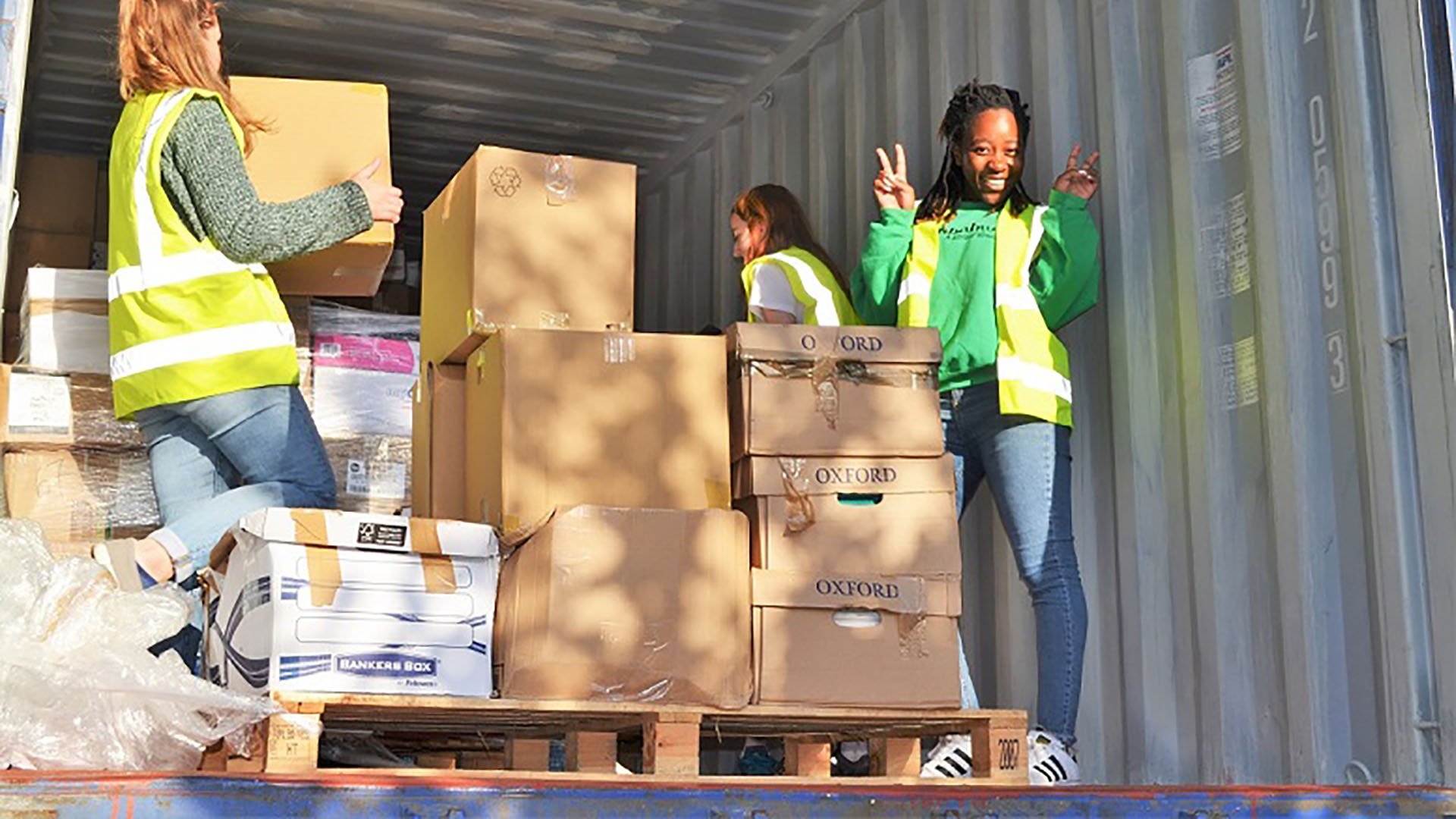
The School in a Box programme matches surplus office furniture to under-resourced schools in countries including Gambia, Ukraine, Romania and the UK. Between 2019 and 2024, thousands of donated workstations from UK corporations have furnished hundreds of classrooms globally.
Typical transformations include:
-
Bench desks converted into classroom desks for students
-
Executive tables becoming teachers’ workstations
-
Decommissioned IT equipment creating ICT suites for digital learning
-
Office storage units repurposed as library shelving
The Gambian Sustainability Cookery School, for example, will be equipped with refurbished office furniture to support vocational training for young people. Borewell Projects funded by clearance proceeds bring clean water to communities. UK charities and community groups also receive furniture, supporting organisations working in skills development and social infrastructure.
What arrives as surplus furniture from a London office leaves as educational infrastructure for a primary school in West Africa. The positive impact extends far beyond waste diversion.
Step 4: Responsible Recycling for Items Beyond Reuse
When items are genuinely beyond repair or unsafe for reuse, responsible recycling becomes the appropriate pathway:
-
Accredited recycling partners process metals, wood, plastics and textiles
-
WEEE including monitors, base units and servers receives secure IT disposal
-
Data wiping certificates and destruction documentation provided where required
-
Full documentation for compliance with UK and EU waste regulations
-
Landfill is avoided, recycling serves as last resort, not default outcome
This approach ensures complete compliance while maximising the value extracted from every item. Recycling costs are minimised because volumes reaching this stage are significantly reduced through prior reuse.
Environmental, Social and ESG Benefits of Reuse-Led Office Recycling Removal
Facilities and procurement leaders now face explicit Net Zero and ESG objectives extending to Scope 3 categories, including purchased goods and waste. Reuse-first office clearance services directly support these targets with measurable outcomes.
Environmental benefits:
-
Carbon savings typically 6x greater than recycling-only approaches
-
Resource conservation through extended product life cycles
-
Reduced demand for virgin materials and new manufacture
-
Zero-to-landfill outcomes achievable for all projects
Social benefits:
-
Schools equipped with functional furniture and IT equipment
-
Vocational training centres supported with workspace resources
-
UK charities assisted with community infrastructure
-
Education access improved in underserved regions
Governance and reporting benefits:
-
Post-project reports showing items reused vs recycled
-
Estimated CO2e avoided with calculation methodology
-
Countries and schools supported with photographic evidence
-
Alignment with UN Sustainable Development Goals
-
Full report documentation suitable for TCFD/CSRD disclosures
Waste to Wonder has redistributed over 1.1 millions office furniture items, diverting over 25,000 tonnes from landfill. These outcomes translate directly into annual sustainability reports, social value tenders and employee engagement communications.
A single office relocation can achieve both quantified carbon savings and concrete classroom transformations, evidence your company can share with stakeholders, customers and staff.
Cost and Procurement: How Reuse-First Clearance Compares to Standard Recycling
Many teams expect reuse and donation schemes to be more expensive than standard recycling or skip hire. In practice, costs are often comparable, sometimes lower.
Key cost components apply whether items are reused or recycled:
|
Cost Element |
Standard Recycling |
Reuse-First Clearance |
|---|---|---|
|
Labour and dismantling |
Included |
Included |
|
Vehicle and transport |
Included |
Included |
|
Site access coordination |
Included |
Included |
|
Compliance documentation |
Basic |
Comprehensive |
|
ESG reporting |
Limited |
Detailed impact data |
|
Social value outcomes |
None |
Schools and charities supported |
Waste to Wonder’s model offsets costs through efficient logistics and high reuse rates, making ethical office clearance a cost effective or budget-neutral option for most projects. A 200-desk London office closure, for example, can cost similarly to a commercial recycling service but result in fully equipped schools in India and detailed ESG reporting for the client.
Procurement and FM teams can specify reuse and social value in tenders. We assist with wording for ITTs, RFQs and social procurement criteria. The refurbishment of your workspace becomes an opportunity to save money on disposal while generating measurable community benefit.
It costs about the same, but does far more good.

How to Choose an Office Recycling and Clearance Partner
Not all “office recycling removal” providers are equal. Some focus on landfill diversion statistics, others on resale revenue, and a smaller group on genuine reuse and social impact. Due diligence matters.
Questions to ask potential partners:
-
What percentage of items are reused intact vs recycled as materials?
-
Which schools, charities or organisations receive donated furniture?
-
Do you operate a zero-landfill policy with verification?
-
What reporting detail do you provide on destinations and carbon savings?
-
How do you handle WEEE and equipment disposal securely?
-
Are you a direct operator or a broker subcontracting to third parties?
Look for partners that evidence past projects with impact data and real beneficiary stories, named schools, photographs, measurable outcome, rather than generic environmentally friendly claims. Discuss specifics about where items actually go.
Waste to Wonder operates as a circular workplace partner, not a skip provider. We do not send furniture to landfill, dispose of assets for profit extraction or strip value without community benefit.
Working with Waste to Wonder Worldwide
Waste to Wonder Worldwide helps organisations across the UK and Europe transform routine office clearances into measurable environmental and social value. Our reuse-first approach gives unwanted furniture a new lease of life while supporting education and community development globally.
Key differentiators include:
-
Reuse-first strategy prioritising intact asset redistribution
-
Global school and charity partnerships through School in a Box
-
Zero-landfill commitment with verification
-
Detailed impact reporting for ESG and sustainability compliance
-
Experience with large, multi-site corporate projects across the country
If you came looking for office recycling removal, consider a reuse-led alternative that empties your workspace just as efficiently while equipping classrooms and community spaces worldwide. Your office clearance can achieve more than compliance, it can achieve impact.
Ready to explore what’s possible?
Learn more about our School in a Box programme and discover how your next office move could furnish an entire school. Partner with us on your next clearance or workplace change, and see how circular solutions deliver for business, environment and communities alike.
